

Our Voices, Our Stories
Where the voices, journeys, and projects of the NPY Women’s Council come alive. Here we share perspectives from across our communities; the wins, challenges, and everyday moments that shape our collective story.
Stories

Growing Hope: The Blue Tree Project
Punu ngaanya mirritjanu warngkaringu – the dead tree comes to life again.
The Blue Tree project began as a conversation during a long car journey between Mparntwe (Alice Springs) and Warakurna, a remote community in the Ngaanyatjarra Lands of Western Australia. The discussion was sparked by the sight of a blue-painted tree at Curtin Springs, part of a national initiative to raise awareness of mental health – and this is what that particular Curtin Springs tree did.

A group of Anangu and Yarnangu women from the Uti Kulintjaku team at NPY Women’s Council developed the idea of making a blue tree out of tjanpi (grass), as a way of reinterpreting this initiative beyond the Western understanding of the tree, and of mental health more broadly, into a way that resonates with Anangu and Yarnangu. They collaborated with Tjanpi Desert Weavers to do this.
Not only was the physical act of making the tree healing, but it also stood as a powerful metaphor to open up dialogue about mental health in a meaningful and hopeful way.

The women talked about looking to the future – nyaakula kuranyukutu – going from a hopeless state – walykurringu – to having hope again, and recovering, returning to happiness – marlaku palyaringkupayi mapalyarringu.
The women often take the tree into Ngaanyatjarra Schools to engage the kids in discussions and meditations, encouraging them to create leaves to hang on the branches as symbols of regrowth. This interactive process shares the story of the blue tree in a way that reinforces the message of hope and healing.

The women hope the tree will travel, sparking many more conversations about mental health across communities, bridging cultural understandings, and bringing people together.
Learn more about the Uti Kulintjaku initiative and Ngangkari Traditional Healers here.
Tjanpi Desert Weavers Honour the Bush Bus
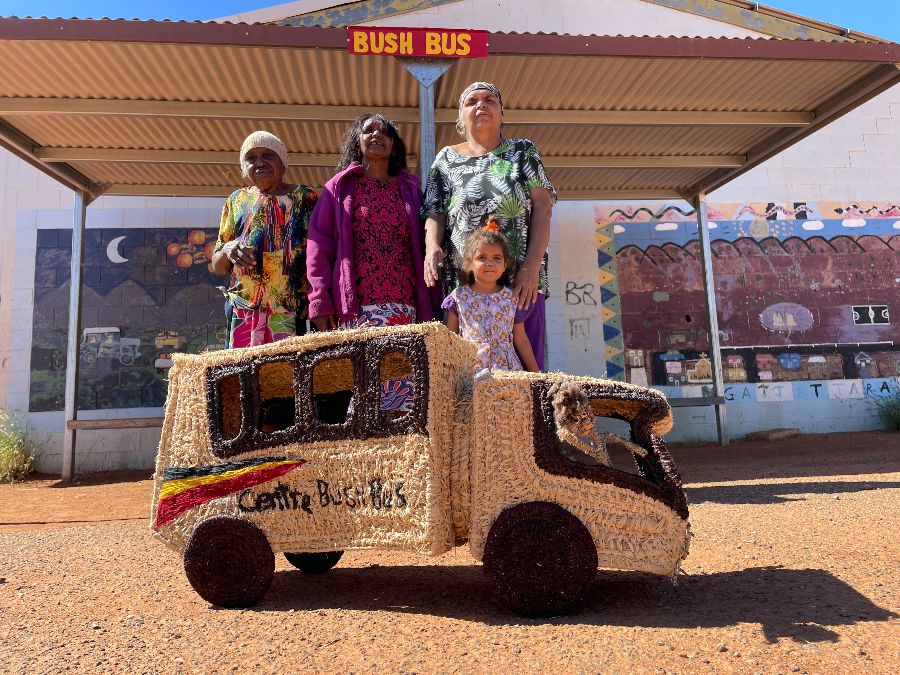
Our social enterprise, Tjanpi Desert Weavers, celebrate the story of the Kaltukatjara Bush Bus by weaving the bus that connected the community to Alice Springs and faraway family.
With many important services based 7 hours away in Alice Springs, families from Kaltukatjara (Docker River) would often miss appointments or find themselves stranded in town, unable to return home… until a local tjilpi (old man) came up with an idea…
In 1998, Alan Passmore, who was working in Kaltukatjara, suggested he buy a bus to help solve the remote community’s transport challenges.
We said “palya”! So he flew to Perth to buy a big new bus, and drove it all the way back. He passed through Warakurna, and saw my son. He said, “This is a new bus for you mob!” Then he drove on to Kaltukatjara and pulled up at my place. Everyone was excited, the kids were all climbing in the bus! The same size as a Greyhound! He took us all for a ride. We were really happy about that one. – Rosalind Yibardi, Tjanpi artist.

The bush bus, that’s our bus. Docker River started that bus, first travelling from Alice Springs to Docker River and back. Now that bus travels all over to help people from more communities get to town. – Winsome Newberry, Tjanpi artist.
Today, the Bush Bus service travels 11 routes across 35 communities, connecting people to services and family. In honour of this important lifeline for families, Tjanpi artists created a woven Bush Bus for the touring exhibition True Story.
Tjanpi helps Anangu women share their stories and culture with the world through fibre artwork to the world and supports income opportunities for women living in a region of economic disadvantage.

We just had to share some wins from a few of our amazing initiatives
Tjanima Tjukurpa Winner of Children’s & Young Adult Book at the Chief Minister’s NT Book Awards 2022
“This book means a lot to us wati because when we were writing it, we didn’t know what we was getting into. But look we knew it was a story about one young fella who got healed with his grandfather. At the end of the day it makes us watis so proud and the NPY Woman’s Council and the Uti Kulintjaku team because we won something and that’s good. And it was good to write in our own language, in Pitjantjatjara, Yankunytjatjara and Ngaanyatjarra. There’s three languages in there and you know its good for Anangu to write books and to see how Piranpa write books because its not easy. It wasn’t easy, wiya! But we are so happy, palya.” Robert Hoosan (pictured)

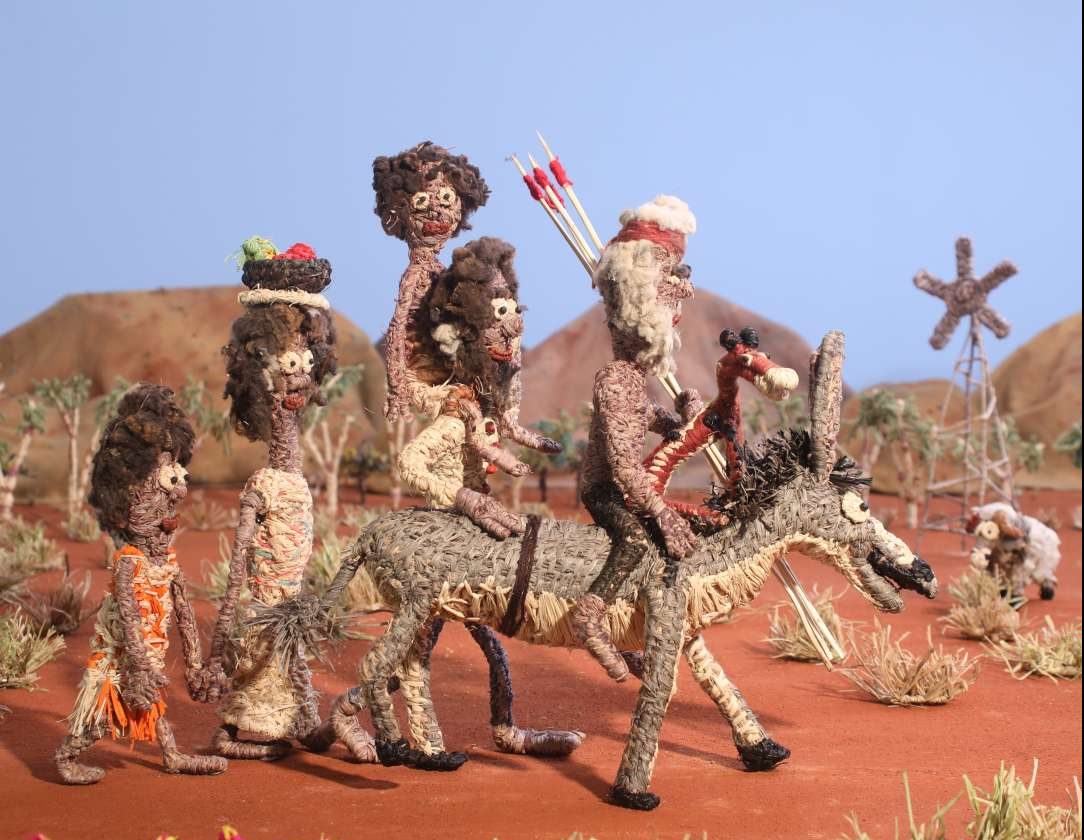
Tjanpi Desert Weavers animation Tangki (Donkey) wins Sydney Film Festival AFTRS Craft Award and the Yoram Gross Animation Award
Tangki is a story the introduction of donkeys to the desert community of Pukatja and the special vond that has formed between Anangu and tangkis.
The animation was a collaboration between Tjanpi artists, Imuna Kenta and Elizabeth Dunn supported by Creative Emma Franklin and Co-Director Jonathan Daw. Picutred below.
This film was supported by the Australian Government’s Indigenous Languages and the Arts program.

Formal Recognition and Support Needed For Art Centres Delivering Care For Elderly
New research shows art centres play important role for the aged in communities
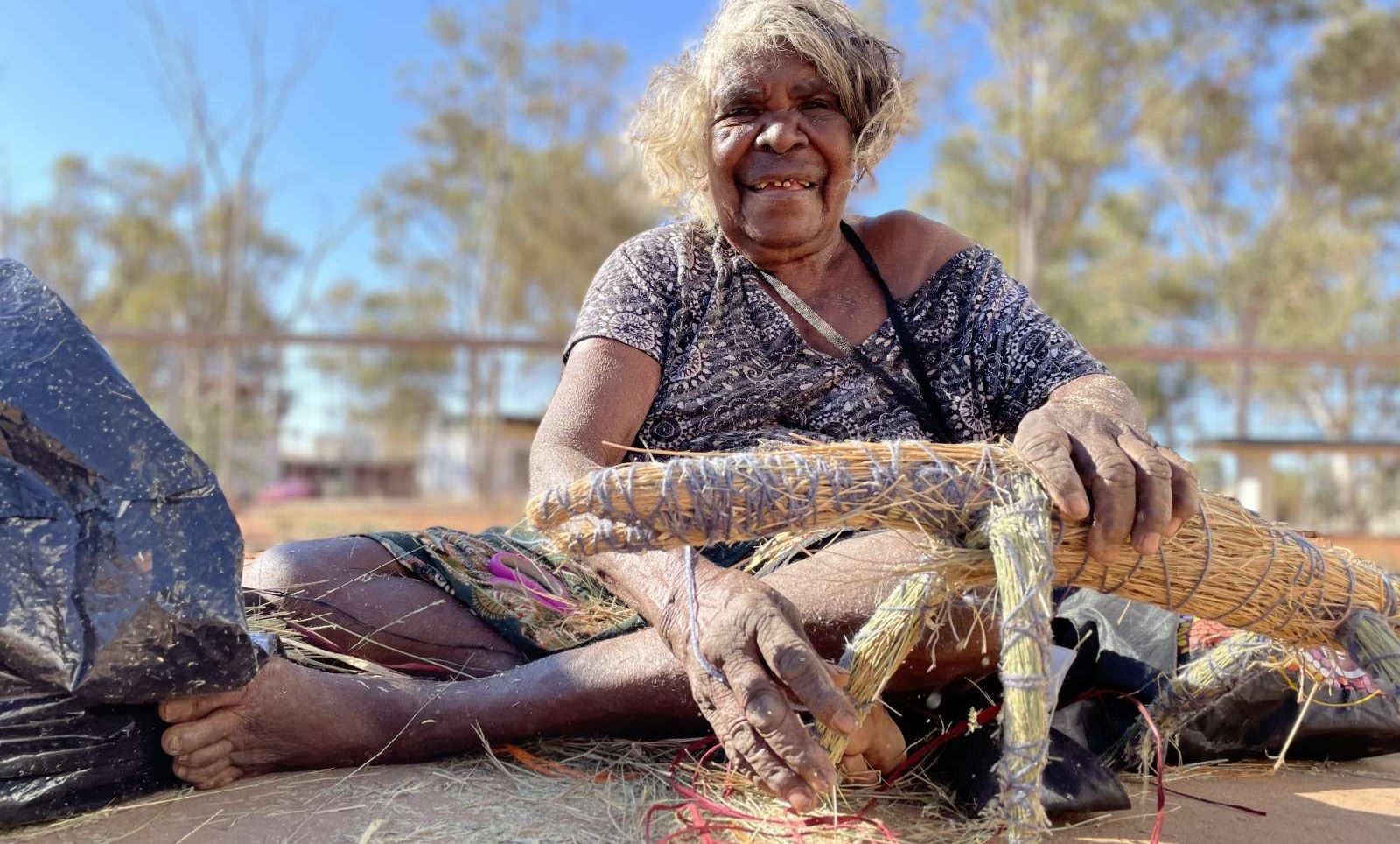
A three-year research study has found that Aboriginal art centres play a key role in delivering day-to-day care of older artists as well as creating a space of healing and respite.
Tjanpi Desert Weavers is a social enterprise supporting and elevating fibre artists from the NPY lands. Many of our artists are older women who not only form the cultural backbone of Tjanpi but also require an increasing level of care.
Art centres like Tjanpi work hard to support elderly artists and their day-to-day health needs, whilst facing challenges such as:
- Lack of formal recognition or resourcing in supporting older artists
- High demands of care from elders and community
- Poorly designed or inadequate infrastructure at art centres
The National Ageing Research Institute worked with Tjanpi Desert Weavers, Mangkaja Arts Resource Agency (Fitzroy Crossing) and Ikuntji Artists (Haasts Bluff) to conduct a research study to understand how three different art centres in remote locations support their older artists. The research study was funded by a Department of Health Dementia and Aged Care (DACS) Innovation grant from 2017-2021.

Key findings of the research include:
- Art centres are considered a safe space, a place of healing and respite, and a place for everyone. They reduce stigma associated with dementia and functional decline; they promote a sense of belonging.
- Art centres play an enormous role in delivering day-to-day care needs of older artists. They also facilitate social connection, spiritual and cognitive wellbeing.
- Elders are at the foundation of the art centres.
- Art Centres work hard to build and maintain relationships of trust and reciprocal models of care.
- Older artists are the senior artists, role models and ‘superstars’.
- The centres prioritise the role of Elders by creating a space where intergenerational connection, teaching and learning, and leaving a legacy are key drivers of their engagement.
- They retain a local workforce and they are in an ideal position to notice physical and cognitive changes in older artists and work with them to promote social, emotional and cognitive wellbeing.
- Elders are integral to the governance systems of art centres. Culture, Country, kin, language and storytelling are embedded into these systems and everything they do.
- The centres are immersed in their Country’s context and the history of their community.
- Many art centres are collaborating with aged care providers and have identified the potential to enhance these collaborations to better meet the needs of older artists and their families. This includes sharing infrastructure, organising joint trips to Country, sharing staffing and expertise across sites.
Tjanpi is currently advocating to government through the Royal Commission into Aged Care Quality and Safety and the recent Productivity Commission to share these keys findings. This research will also be shared through peer review journals such as the Australian Journal of Ageing.
You can learn more from the following audio visual resource.
https://www.nari.net.au/art-centres-supporting-elders-a-good-news-story
Winning hearts, prizes & income for remote artists
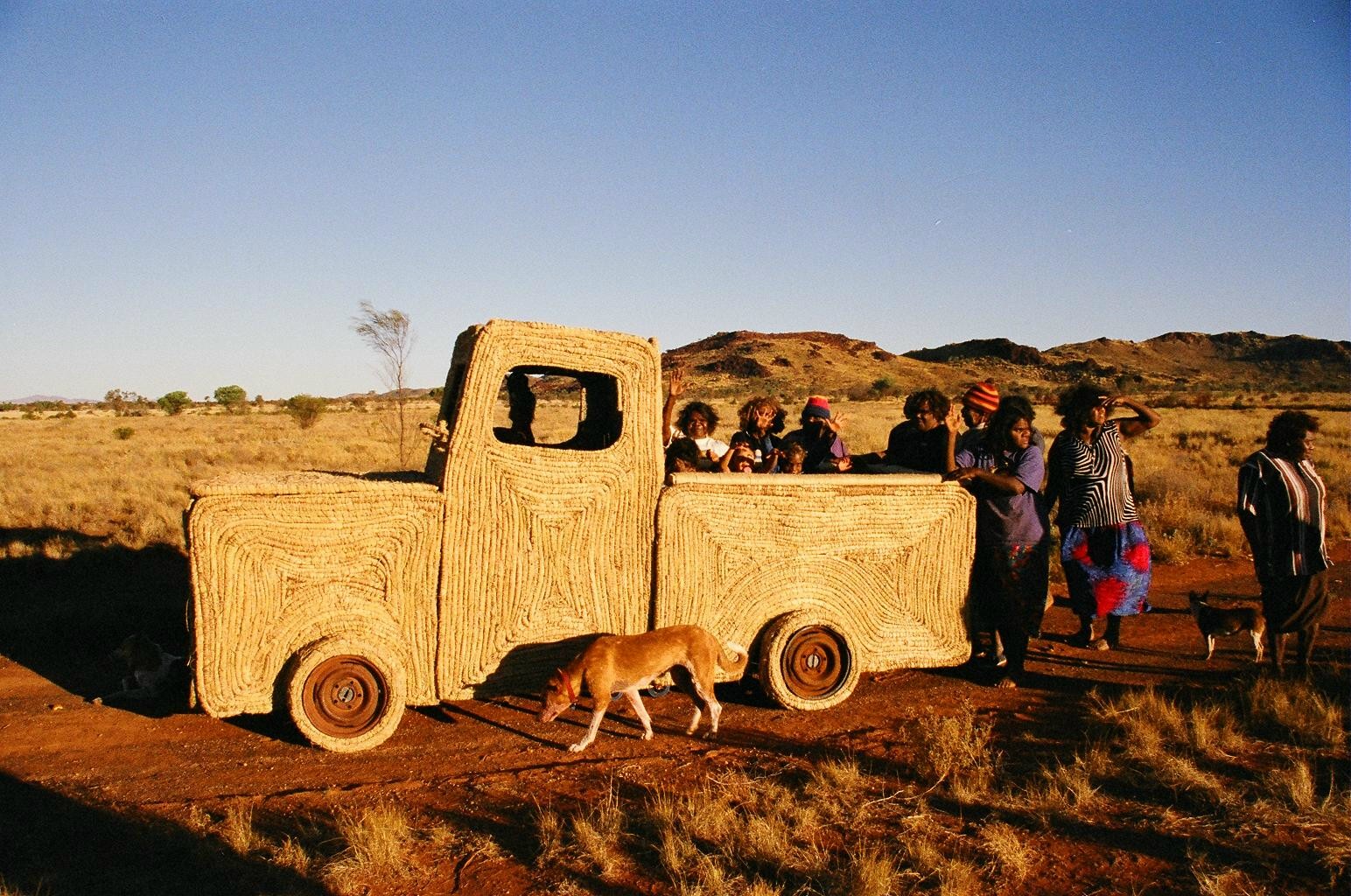
Made beside the Blackstone Ranges, the tjanpi Toyota drove itself all the way to Darwin where it came right at the top of the 2005 Telstra National Aboriginal and Torres Strait Islander Art Award. Mrs Benson (dec)
The Toyota celebrated the significance of peoples’ ability to travel big distances, to sustain customary practices like hunting, visiting relations and undertaking ceremonial responsibilities.
10 years earlier Tjanpi Desert Weavers had just begun with a series of fibre weaving workshops and the hope that that weaving could provide a “bread and butter” income for women in remote communities….

I was so proud that day! It was wonderful to be recognised and to be able to represent all the other weavers, especially the young ones who had helped. We had worked as a team and made group decisions. That’s what made it so enjoyable. It was a team effort. All the younger ones were very participatory ad has listened to our advice, and taken our suggestions on board. We enjoyed that part of it and that is what made the whole thing so special.’ – Mrs Benson (dec.)
Tjanpi Desert Weavers Women wanted meaningful and culturally appropriate employment on their homelands to better provide for their families – money saved from their work could provide meals, travel and vehicles of their own.
Building upon a long history of using natural fibres to make objects for ceremonial and daily use, women took quickly to coiled basketry and were soon sharing their new found skills with relatives and friends on neighbouring communities.
Now, in 2021 Tjanpi has provides income for over 400 Anangu women, it has exhibited and been acclaimed in public and private art institutions across Australia and the world.

Rene Kulitja and some of the Tjanpi work featured in the Venice Biennale
Making the road to Warburton - Judith Chambers
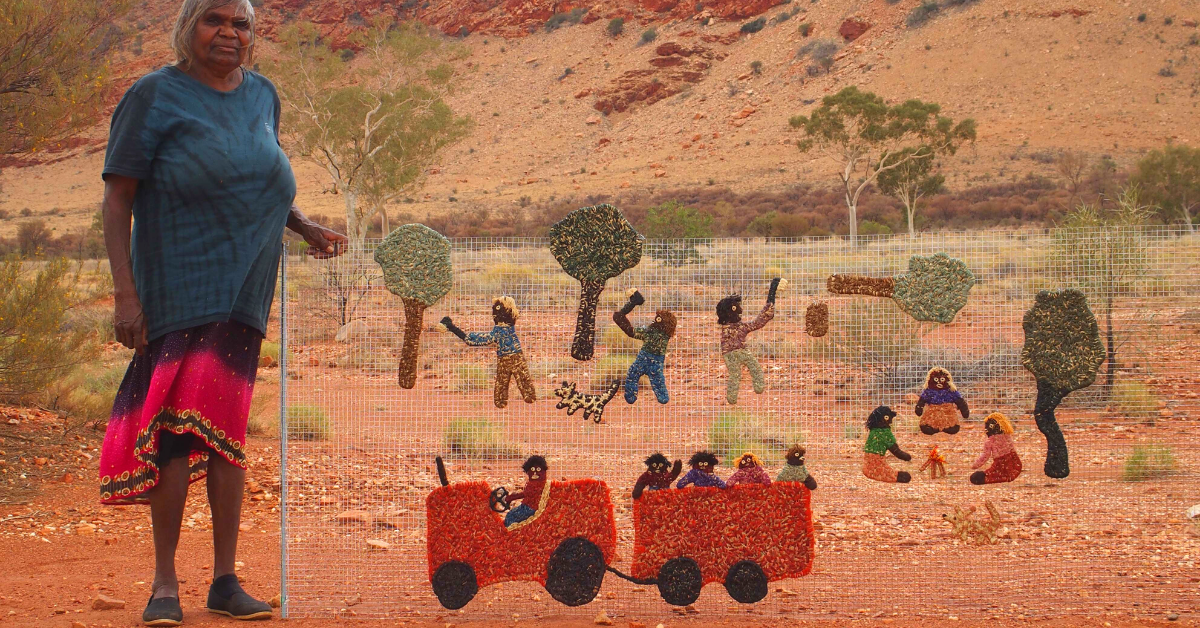
The “Making the Warakurna to Warburton road” story
There was only one road from Warakurna to Warburton and it was a big distance, going the long way around, passing through Blackstone. So there was a community talk, and people wanted a road running straight from Warakurna to Warburton, to make that trip shorter.
Lots of families from Warakurna and Warburton came to help make the road, men, women, children and dogs. My dad was one of those men. I was just a young girl. We started at Warburton. The men made the cutline, chopping down trees by hand with axes, and clearing grass. The women made the fire and prepared food and looked after the camp. While the adults worked we would have fun. There were lots of children and dogs running around playing together. A white man came and paid money for the work done. We all stayed out on the road until that road was finished.
Two brothers drove the tractor, taking it in turns. The tractor had a trailer which stored food, 44 gallon drums of diesel, and blankets. We would get lovely clean water from rockholes. Sometimes we would get in the trailer and play. Each day the men would clear a bit more of the road, and we would move on and camp somewhere else, getting closer and closer to Warakurna every day.

The Artwork
Judith was commissioned by the Art Gallery of Western Australia (AGWA) Stimulus Acquisition Package 2020 to tell this story as a tjanpi sculpture. Titled ‘Making the Warakurna to Warburton Road’ The sculpture was purchased by AGWA, and will be exhibited at the AGWA Covid 19 Stimulus Art Exhibition scheduled for early May 2021.

About Judith
Judith was born in the bush at Mitika, near Jameson Community and went to school at the Warburton Mission and later at Docker River. Judith now lives in the remote community of Warakurna, WA.
Judith is an accomplished weaver, making both baskets and fibre sculptures from desert grasses that grow close to her home. Judith is renowned for her flat sculptural works which tell stories of the Ngaanyatjarra Lands, both historical and contemporary; she also uses the animals from her country as inspiration, including camp dogs, birds, goannas, porcupines and rabbits. Ancestral figures also inspire her work, and Judith’s work is very fine and detailed. Judith also paints and is represented by Warakurna Artists.
Kungkarangka at the National Gallery of Australia
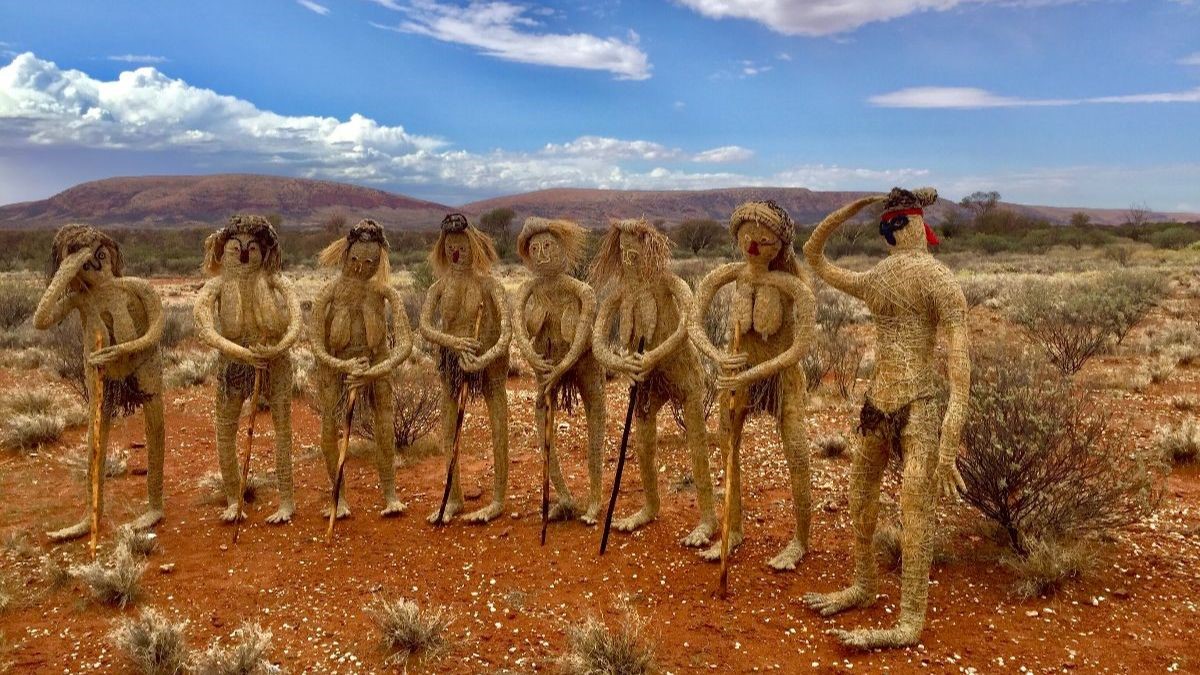
Kungkarangkalpa (Seven Sisters) by Tjanpi Desert Weavers is a collaborative large-scale installation commissioned by the National Gallery of Australia as a part of the Know My Name: Australian Women Artists 1900 to Now exhibition.
Kungkarangkalpa (Seven Sisters) is an epic ancestral story. It follows the journey of seven sisters as they are pursued across Country by Wati Nyiru / Yurla, who is chasing the eldest sister. The sisters constantly try to evade Wati Nyiru leaving traces of their journey in the landscape. In an attempt to escape, they eventually launch themselves into the sky, transforming into the stars that form the Pleiades. Wati Nyiru follows and becomes the Orion constellation. The retelling and depiction of this story relays the impact of transgressive behaviour and location of water resources necessary for survival in the desert.

Know My Name is an initiative of the National Gallery of Australia to celebrate the significant contributions of Australian women artists. The initiative aims to increase the representation of artists who identify as women in its artistic program and enhance understanding of the contributions they have made and continue to make to Australia’s cultural life.
Contributing artists: Dianne Ungukalpi Golding, Delilah Shepherd, Winifred Puntjina Reid, Dorcas Tinnimai Bennett, Martha Yunurupa Ward, Nancy Nyanyana Jackson, Polly Pawuya Jackson, Cynthia Nyungalya Burke, Erica Ikungka Shorty, Judith Yinyika Chambers, Rosalie Richards, Dallas Smythe, Roma Yanyakarri Butler.
Creating a space to weave, connect & check in
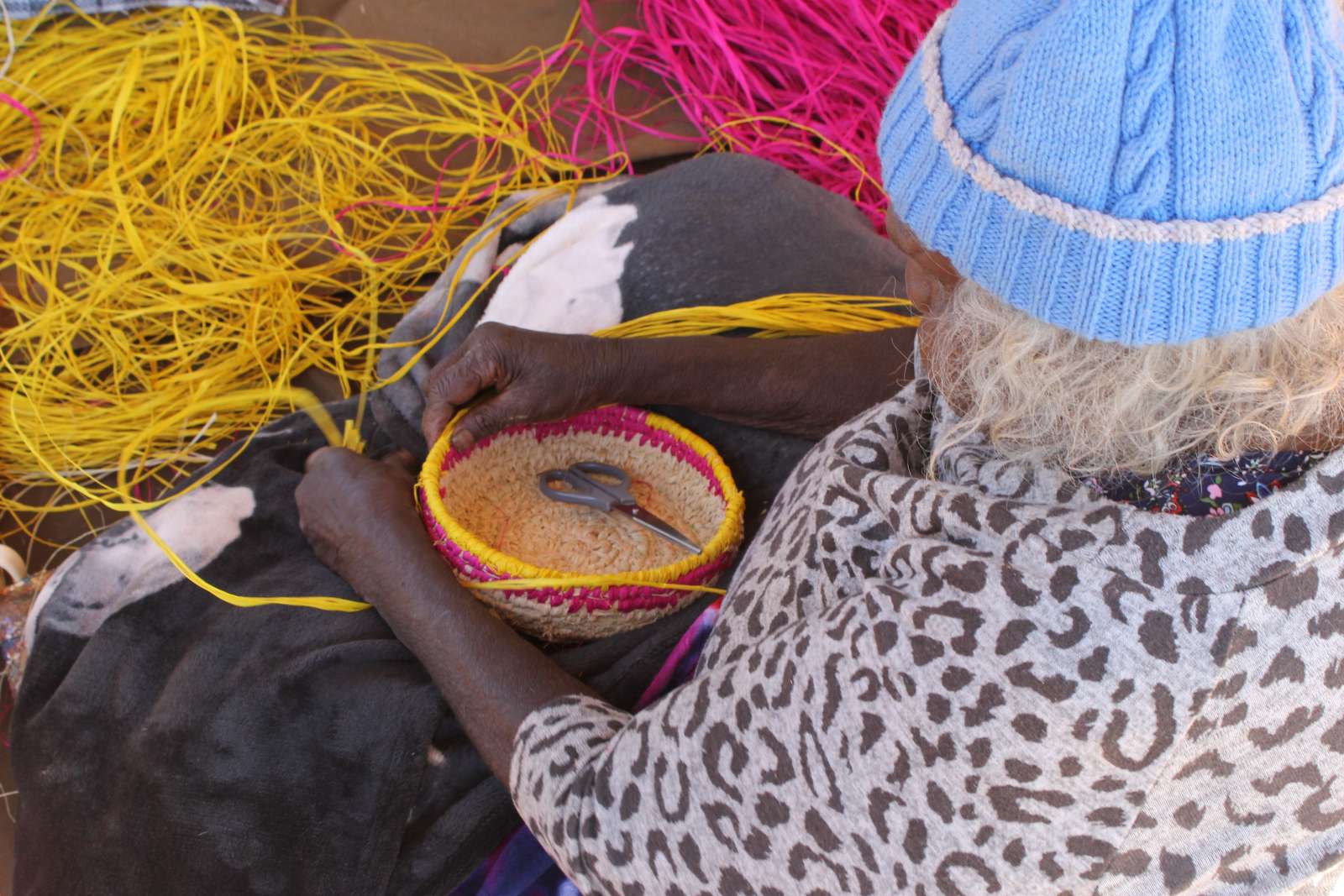
In the first set of Tjanpi workshops since biosecurity restrictions were lifted, Tjanpi loaded a car load of Tjanpi supplies for hungry weavers. The workshops offered an opportunity to reconnect, weave and talk about people’s wellbeing during the pandemic. The workshops were a new collaboration between Tjanpi and the NPYWC Domestic & Family Violence Service and supported discussion around the threat of heightened family violence during COVID lock-downs.
Workshops in Docker River and Mutijulu created a space to weave, talk and reconnect after limited travel during biosecurity measures in the NPY Lands. In a relaxed and supportive environment, Tjanpi and the Domestic & Family Violence Service (DFVS) were also able to pave the way for deep and profound discussions regarding domestic and family violence.
While successful in producing amazing new tjanpi work, the workshops have also provided the opportunity for new relationship building and DFV awareness.
This project was funded by the Central Land Council grants supporting: Provision of support services for residents of Aboriginal communities affected by restrictions imposed to reduce the spread of COVID-19
Find out more about NPYWC Family & Domestic Violence Service