Skip to content

Your donation supports the voices and leadership of Aṉangu women across the Ngaanyatjarra, Pitjantjatjara and Yankunytjatjara Lands. NPY Women’s Council is an Aboriginal-led organisation created by women for women, focused on improving health, safety, culture and community wellbeing in remote Central Australia.

We appreciate any contribution you are able to offer.

Please fill out the form below to make a donation.

Cart

Your cart is empty

Donate

Article: Anangu understandings give better support for women experiencing sexual assault

npy womens council

Anangu understandings give better support for women experiencing sexual assault

“Here is a Ngaanyatjarra woman who has gone through many things in her life, violence, assault and sexual assault. She has many problems. She is just sitting there and thinking, “Who can I trust? Who can I trust to help me? To encourage me? Where can I go for guidance and encouragement to put me on the right path? So I can have hope in my life.” And after that, “How can I get healed, my whole life and be strong? So in the end I can be happy, have a good husband, have kids and a happy life. Forget all those other things that have happened behind.” Anangu Co-Researcher. Read about the Domestic & Family Violence Service’s new paper and how trust, language and relationships can help to heal and inform DFV practice.

The NPYWC Domestic & Family Violence Service’s (DFVS) new research paper “Exploring Anangu understandings to strengthen support for Anangu women experiencing sexual assault” asked:

  • What are Anangu understandings of sexual assault and its effects?
  • How do you talk about sexual assault with Anangu women in a safe way?
  • What support do Anangu women need if they have experienced sexual assault?

Anangu and non-Aboriginal DFVS staff, a psychotherapist and senior Anangu women from NPYWC’s Uti Kulintjaku (clear thinking) initiative worked together to answer these questions and find the best way forward to support Anangu women who have experienced sexual assault.

We are feeling empowered by this process to explain that we need to slow down and think about this work more carefully and talk about it in the right way and this has been informed by the knowledge of these senior Uti Kulintjaku ladies… The Uti Kulintjaku team work in a very slow, careful way to really look at words and ideas and Anangu knowledge… To say things in the right way, carefully. We know we can stop and slow down, we have the knowledge.” Anangu co-researcher

A<span style=

This is about the knowledge growing from when the minyma, Uti Kulintjaku team and the DV team first got together. We have started to do something and this is coming through, coming in to the DV team. We talked about secret language that came up at this workshop, strong Tjukurpa that has been hidden and was shared by the Uti Kulintjaku ladies. It’s like the pretty flowers, it made me really happy. Thank you, I’m really happy that you are here and sharing this Tjukurpa. Now it’s really big, it’s like the pretty flowers. Anangu co-researcher

Here are some of the ideas discussed in the report:

Language & Culture

The importance of language and knowledge of culture and community were seen as central in supporting women who have experienced sexual assault. The need to work sensitively in small communities where many people are related to ensure trust and maintain confidentiality. Anangu women described the way of speaking “sideways” or kiti-kiti wangkanyi as the appropriate Anangu way of talking about sensitive issues to ensure that further hurt, distress, shame or offence is not caused.

Trust & Relationships

Trust and finding the right person for an Anangu woman to talk about her experience of sexual assault is important –a woman that she already has a loving and caring relationship with like a mother, grandmother or sister is an important support.

In our communities, domestic and family violence causes a lot of sadness and distress. This work [is strengthening our idea that when piranpa come and go from communities, they don’t hold the knowledge and history for a long time in the way that Anangu do. They don’t know the families and the relationships and all the information about what is happening in communities. So it is really important that when workers come from outside they need to have a malpa – an Anangu worker working alongside them and to listen to them nangu worker> and be guided by their knowledge because they are the ones living in the community all the time and they are the ones who know the right people to speak to, the right way to go about it. Anangu co-researcher

We got together to talk Anangu and piranpa, and then going back to the communities and talking with the young women, it can help. It’s in the communities, it’s happening, going out there to talk to them. Making them feel happy and good inside by sharing that story. So they can feel like a rainbow, special. What I think is that the learning and sharing is starting and helping to start talking like with the girls and the senior women together. We are strong women doing the work and the circles in the drawing are growing as we are getting stronger, feeling stronger to take it back out to the young women, each time we come together.
Find out about the Uti Kulintjaku initiative

Read “Exploring Anangu understandings to strengthen support for Anangu women experiencing sexual assault” report here

Read more

aboriginal health nutrition
Child & Family Wellbeing

Anangu researchers give nutrition study real meaning

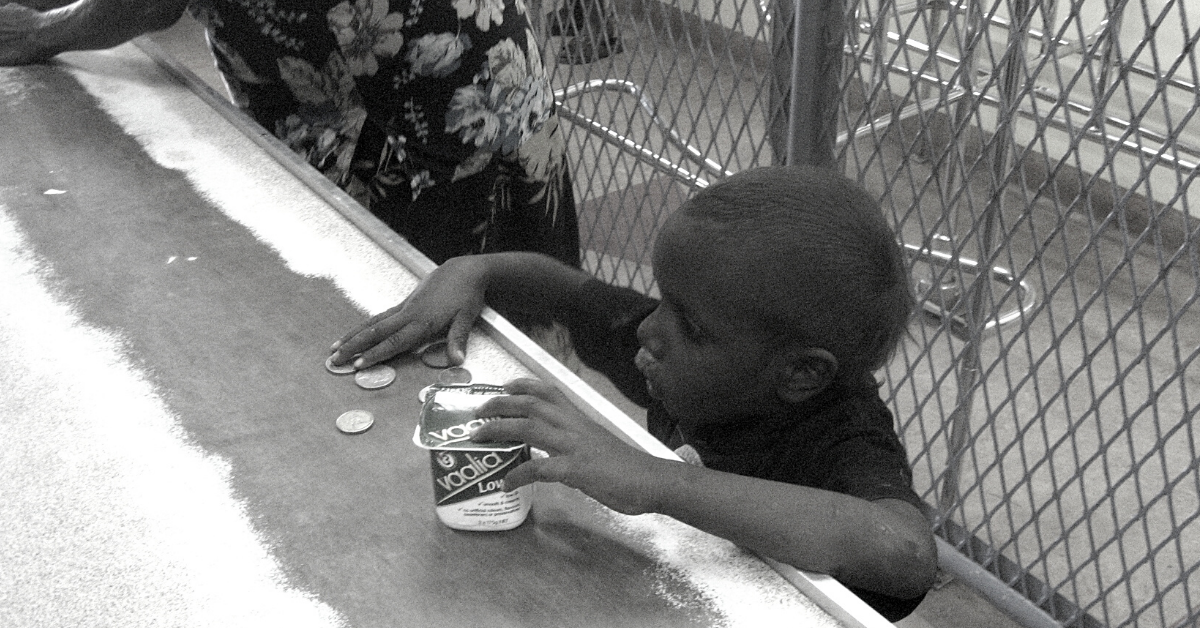
Anangu nutrition staff are preparing to head an important new study investigating food security in the APY lands. Their central role as co-researchers will grow greater community engagement, relevant interpretation and greater outcomes for community members. The research is a joint initiative between NPYWC, University of QLD & Menzies School of Health Research.

The aim of the research is to improve nutrition and food security in the APY region through an analysis of people’s buying habits and the development of culturally appropriate nutrition education and promotion resources.

The project hopes the research will lead to the following outcomes:

  • evidence to inform policy and systems change, based on feedback from research looking at availability, affordability and accessibility of healthy foods in community stores
  • Development of co-designed priority nutrition education and promotion activities for APY communities
  • Increased engagement between NPYWC and Mai Wiru Regional Stores
  • Community-relevant knowledge translation products
  • Peer reviewed publications

Anangu Co-Researchers will undertake training in privacy and confidentiality, conducting surveys and understanding and interpreting data.

Find out more about NPYWC’s Child & Family Wellbeing Service

Read more
Linda Eddy NPY Womens Council
Tjungu

The Ngaanyatjarra Carer

For over 20 years Linda has worked as an Aged & Disability Worker in the remote deserts of WA. Linda has also been a carer for her husband and daughter Janine, born with a disability. Read more to find out about Linda’s story, her 2 week walk to school and the 3 things she describes as important for people working with Anangu in remote communities to know.

I grew up in Warakurna with my family. When I was a bit older we moved to Warburton so we could go school and get an education. At the time Warakurna didn’t really have a school. It took us two weeks walking to Warburton from Warakurna – we hunted and slept along the way. When I had finished my schooling, my family and I moved back to Warakurna.

Back in Warakurna, I met my husband and helped grow up my sister’s children. Later my husband and I moved to Wingellina and I grew up my daughter, Janine.

In Wingellina I worked as a health worker with Nyaanyatjarra Health Service for nearly 20 years. We travelled and worked with other communities nearby: Blackstone, Jameson, Warakurna. After that I worked in the store.

linda eddy A<span style=

One day I went to a NPY Women’s Council meeting near Kalka. I had not heard of NPY Women’s Council. I was listening to what they were saying. A friend of mine had started to work for NPYWC and a lady, JC asked me “Do you want to work for Women’s Council?” and I said “yes”.

One of the NPYWC Director’s, Nancy Young told me “That’s good you working for Women’s Council.”

It’s now today 2021 and I am still doing that work!

In my work I take old people and people with disabilities for bush dinners, I help clean their room – mopping and all that, I help them with their accessibility needs and I translate for people.

Sometimes Anangu don’t understand what the doctors are saying to them, I help them understand. I also help people with a disability or old people connect with health workers and services.

The best part of my job is seeing all the clients in Warakurna, Warburton, Blackstone, Jamieson, Wanarn and helping them out. I tell staff what the clients need.

A Funny Story

One day we were driving back to Wingellina from Amata and I said to JC “Oh you see that woman on the side of the road, standing there, and she was waving to us, you didn’t see, but I seen it”. We stopped nearby to make kangaroo tail for lunch and M said “we have to go back to get that lady, she still there waiting, we got to pick her up – poor lady”. So JC and M went back down the road to pick up the waving lady. They drove around but in the end they realised what I thought was a waving lady was really just a tree that looked like a woman.

Three important things to know when you work out bush

Nintitjaku – to learn

Malpa – friend

Purkara Purkara – go slowly

linda eddy npy womens council

Read more about the NPYWC Tjungu Aged & Disability Service here

Read more