Skip to content

Your donation supports the voices and leadership of Aṉangu women across the Ngaanyatjarra, Pitjantjatjara and Yankunytjatjara Lands. NPY Women’s Council is an Aboriginal-led organisation created by women for women, focused on improving health, safety, culture and community wellbeing in remote Central Australia.

We appreciate any contribution you are able to offer.

Please fill out the form below to make a donation.

Cart

Your cart is empty

Donate

Article: NGAPARTJI NGAPARTJI: WORKING & LEARNING TOGETHER

NGAPARTJI NGAPARTJI: WORKING & LEARNING TOGETHER

NGAPARTJI NGAPARTJI: WORKING & LEARNING TOGETHER

As a lead Aboriginal service provider and employer, NPYWC has developed a formal framework that equally acknowledges and values both western professional disciplines and Anangu cultural and contextual knowledge within the workplace.

NPYWC is leaving traditional employment paradigms to better engage staff in Central Australia’s cross cultural context.

Ngapartji Ngapartji is the first edition of NPYWC’s Workforce Development & Capability Framework and is a holistic and evidence based approach to Aboriginal employment at NPYWC.

The framework is unique to NPYWC’s context, and importantly, requires Anangu cultural skills and knowledge to be embedded in all areas of practice. It believes that both Aboriginal and non-Aboriginal employees are essential to the operation of the organisation to ensure the right mix of values, knowledge and skills.

During conversations with Aboriginal and non-Aboriginal staff, members and clients, it became clear a traditional approach to Aboriginal workforce development would not sufficiently address the values and aspirations of the organisation. Relationships, language and culture, growing through work and empowerment were all strong themes that people felt needed to be acknowledged and included in this document.

The Workforce Development and Capability Framework places the responsibility on everyone to be constantly learning and developing, whilst contributing to the shared goals of the organisation.

The framework focuses on deeper learning in the areas of cultural safety, cultural awareness, knowledge exchange (both ways’ learning), malparara way and trauma-informed practice.

These areas contribute to a working environment that we feel, sustainably and realistically improves Aboriginal employment. It was important to NPYWC that the framework aligned with similar models and philosophies of work already created in the organisation.

Download Workforce Development & Capability Framework 1 & 2

Read more

Exploring Anangu Legal Awareness
Domestic & Family Violence

Exploring Anangu Legal Awareness

COVID-19 inadvertently created an environment for learning due to the NPYWC Domestic & Family Violence Service‘s (DFVS) forced slowing down of pace. DFVS’s Specialist Legal Educator and Anangu staff were able to explore legal / illegal behaviours and current misunderstandings around legal issues.

“……it comes as a shock to them when the police have a warrant for their arrest. This shock comes to both her and him and the family.” Anangu Support Worker

An DFVS Anangu Support Worker talks about her experience: I drew this picture after we were having talks about legal issues. We were trying to get a better understanding of how Anangu think about domestic violence orders (DVOs).

In the Anangu community, they think it’s none of their business when partners have a fight. The fight might start after they have a drink then maybe they start arguing about the money saying things like ‘You spent my money!’ People around think he’s just going mad, they might say: ‘I just heard something happening’, but they don’t do anything.

They don’t know that there are legal things there – the threating and the violence is there and it’s not good for the kids, it’s like trauma is happening for the kids.

A problem here is that people think its ok to leave it – ‘they are husband and wife – it’s their business – the neighbours think they are married so they don’t need to talk to the police, but sometimes things get worse for months and years. They are hurting the kids and each other. Then they get to the legal stuff the police come in and those things from the past (like a previous DVO/warrant) and they are going to affect you now. They have been saying ‘it doesn’t affect me’, then it comes as a shock to them when the police have a warrant for their arrest. This shock comes to both her and him and the family.

They don’t know how important it is to understand. It is a big thing now they have to know about. It can affect the family and the children. It is affecting the woman and the man. Both need to have a clear picture. It will affect you now and in the future. They can come together in the middle and talk about the DVO and what it means. They need to know that the DVO can help to stop the violence.

They need to understand that their behaviour is illegal. People don’t know what is legal or illegal behaviour this knowledge is hidden. Good legal education is important because people understand their rights but also the effects of their behaviour.

The difference came for me last week when we looked at the cards because there’s a story that explains legal and illegal behaviour. I’m ready now if violence comes in. I know what is legal and illegal, I’m thinking about the idea of the narrative therapy metaphor of ‘violence’ . Now there is something to say to it: ‘You are illegal!’

It’s gone from being – the man and woman walking towards each other to sort out the DVO, to now we have a better understanding so that she can say to him ‘I want you to be my husband and a father to the children but you need to understand the DVO’. In the middle of the picture is about the going to court time, the legal statements, the lawyers, how are we going to fix this? Lots of worries.

Now the couple are coming together in the middle to sort it out, they come out with release, relief, the mind is open. Learning happens in the middle, they come up thinking about the future. How can the legal story make them a better person? A better parent? A better husband or wife? There can terrible stress in the middle but it can be a positive thing if people understand.

Using training from the NT Legal Aid Commission’s Blurred Borders resource kit DFVS staff spent time discussing and building greater understandings around legal stories about restraining orders, conditions, police, and arrest. The DFVS now holds a greater understanding of gaps in community knowledge that can now be addressed through a fledgling DFVS legal education project.

Staff talked at length about threats, power and control, the word ‘psychological’ and emotional harm, which Anagnu staff equated to spiritual harm. These conversations have led to all staff developing a more nuanced exploration of legal/illegal behaviours, and the purpose of a DVO and criminal procedure being to create protection, not trouble.
Read more
Aboriginal Indigenous Raise the Age
Child & Family Wellbeing

NPY Women’s Council calls on government to stop imprisoning children

It is alarming that children as young as 10 can be arrested, charged and imprisoned in Australia. Every year, 600 Australian children between the ages of 10 and 13 are locked up in prison and sadly 65% of these children are Aboriginal or Torres Strait Islander.

NPY Women’s Council Directors support the #RaiseTheAge campaign and stand with other Aboriginal leaders to advocate to raise the age. NPY Women’s Council agrees that Australia’s minimum age of criminal responsibility should be raised to at least 14 years to align with the recommendation by the UN Committee on the Rights of the Child.

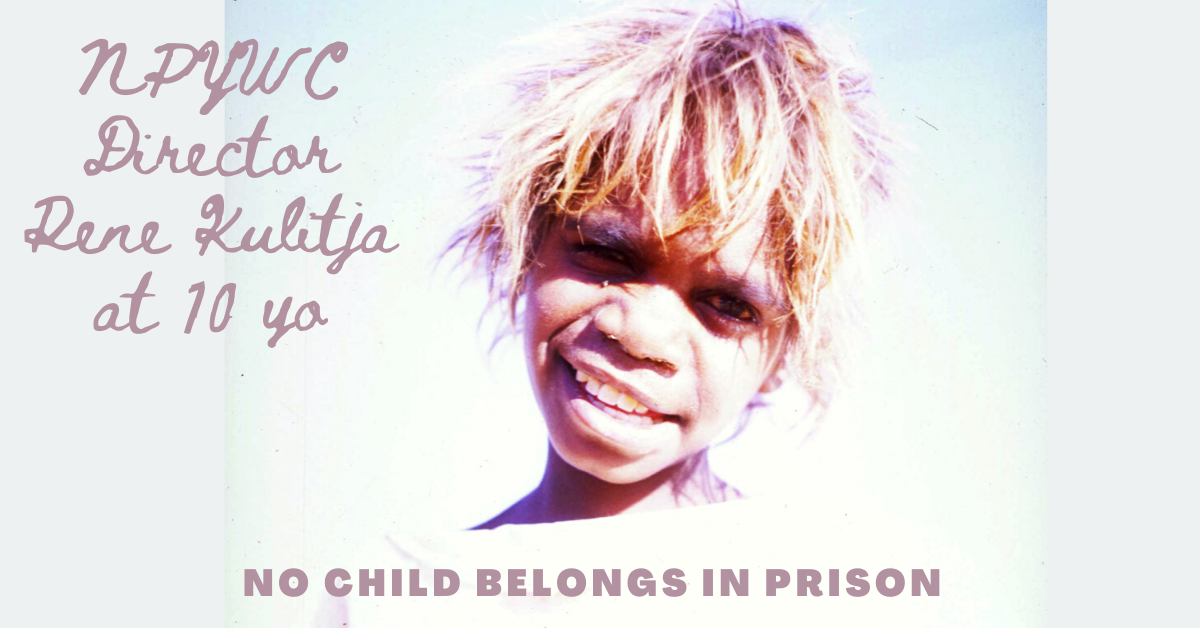
NPY Women’s Council Director, Yanyi Bandicha at 10 yo

“They are learning and they are too young to be locked up, they have a long way to go before they know what is right or wrong and what is good for them,” – NPY Women’s Council Director, Maimie Butler

In July 2020, Australian lawmakers at the Council of Attorneys-General failed to make a decision to raise the age, deferring this to 2021. The ACT government are the first jurisdiction to agree to align its laws with the UN’s recommendation. NPY Women’s Council Directors call on the Commonwealth, state and territory governments to follow the footsteps of the ACT government and protect Australia’s next generation.

Director Yangi Yangi Fox at 10yo (left)

The 2017 Royal Commission into the Detention and Protection of Children in the Northern Territory found that a hard-line approach would not reduce crime, hence one of their key recommendations was to raise the age of criminal responsibility. Research has found that children jailed before the age of 14 are three times more likely to re-offend.

“Governments have been locking kids up for a long time, and yet youth crime is on the rise… There is plenty of evidence that supports a different approach to tackling crime,” – NPYWC Youth Service Manager, Christine Williamson

NPY Women’s Council Youth Service works within research and evidence based frameworks that acknowledge school attendance and reducing family violence are key influencers in reducing youth anti-social and criminal activity. NPY Women’s Council believes that the best place for a child is on country, with family and culture not in jail.

“They shouldn’t be locked up, they need the chance to sit with their family and learn more about what is right or wrong. If they are locked up at that age (10yrs) all they know is how to obey the security guards and live in jail, it is not right,” – NPY Women’s Council Director, Maimie Butler

Christine Williamson, Manager of NPYWC’s Youth Service, calls on Australians to “sign the petition, write to your local member, educate yourself about the issues and what works and share this with others in a way they will understand,”

Actions:

o Show your support and sign the petition: https://www.raisetheage.org.au/#petition

o Write to your local member

o Donate to NPYWC Youth Service

Read more