Skip to content

Your donation supports the voices and leadership of Aṉangu women across the Ngaanyatjarra, Pitjantjatjara and Yankunytjatjara Lands. NPY Women’s Council is an Aboriginal-led organisation created by women for women, focused on improving health, safety, culture and community wellbeing in remote Central Australia.

We appreciate any contribution you are able to offer.

Please fill out the form below to make a donation.

Cart

Your cart is empty

Donate

Article: Meet  Kaltukatjara's Trailblazing Year 12 Graduate!

Meet  Kaltukatjara's Trailblazing Year 12 Graduate!

Meet  Kaltukatjara's Trailblazing Year 12 Graduate!

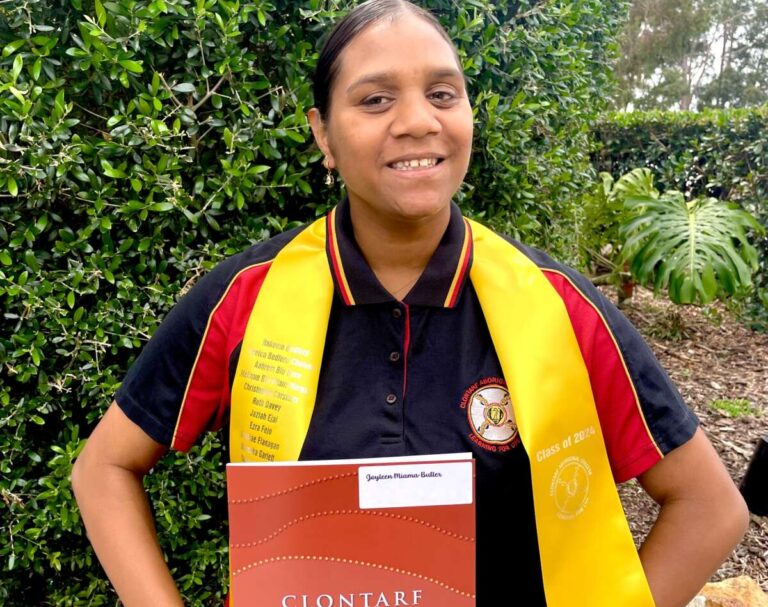
Joyleen is the first person to graduate year 12 from Kaltukatjara (Docker River) in 10 years and she is ready to start work.

After spending two years at Clontarf Aboriginal College in Perth, nearly 2,000 km away from her home, Joyleen has completed her year 12 studies in what is a significant milestone for herself and her community.

Joyleen voted pizza as her favourite boarding school meal, heartfully encourages other young people to try boarding school and talks about how boarding school has opened up a whole new world.

Listen to Joyleen talk boarding school

Communities like Kaltukatjara (Docker River) face big challenges—finding teachers willing to work outbush, some schools so small that kids from Year 7 to 12 share a classroom, and funding models that just don’t fit their needs. NPY Women’s Council Boarding School Program is bridging the gap, offering students and their families the support they need to access education.

Year 12 Formal Snapshot!

Graduates of the boarding school program often flourish afer graduation having gained confidence and learning to navigate both urban environments and the wider non-Aboriginal culture. Although boarding school is sometimes not the first choice for families, for some it is the only path to continue their education and pursue tertiary studies.

Find out more about our Youth Service

Read more

Footsteps of Ancestors: A Walk to Nurture Culture and Wellbeing
Ngangkari Traditional Healers

Footsteps of Ancestors: A Walk to Nurture Culture and Wellbeing

Before colonisation, Anangu travelled tjina ankunytja (by foot) the path joining the important water sites of Kulpitjata, Wala, Tjapiya and Mutitjulu.

A 50km wati (men’s) walk from Kulpitjata to Mutitjulu was conducted with the goal of reconnecting younger men with their ancestral country, law and tjukurpa.

aboriginal men

For NPYWC’s Uti Kulintjaku Watiku team and other men involved the walk was a positive step in nurturing the wellbeing of younger men. The ‘inseparability’ of place (Country) to Anangu wellbeing and social cohesion is well supported in public health literature.

The walk was first proposed by senior man Stanley Windy, who saw the walk as a way to reconnect the men with culture and nurture wellbeing.

Over 30 men from across the NPY lands participated, including senior men who led daily alpiri—traditional morning gatherings that set the agenda and tone for the day. Along the journey, they shared tjukurpa, taught important cultural protocols, and discussed wellbeing supported by NPYWC mental health resources made by Anangu men from the Uti Kulintjaku (clear thinking) Watiku program.

standley windy

” my spirit and health have been lifted up”
David Miller

At the end of the walk, families and community leaders gathered to welcome the young men and celebrate their achievement. Community leaders Sammy Wilson, Rene Kulitja, and David Miller addressed the group, underscoring the significance of the walk.

For the young men, the walk reinforced their connection to place, culture and each other.

Recently, the Uti Kulintjaku Watiku Team rediscovered the Uwankara Palyanku Kanyintjaku (UPK) Nganampa Health film made in the 1990’s entitled “The Rope Story”.

Many of the tjilpi (old men) in the film were the fathers, grandfathers and uncles of current the Watiku Team members. In one section of the film, the men reflect on the disintegration of Anangu society that they are witnessing. They use a piece of rope to illustrate their point. The rope has three strands. These strands represent manta (land) kurunpa (spirit) and Anangu (people). The external influences of colonisation (including alcohol, drugs etc) have caused these strands to separate. The work needed now, the old men claimed, was for the three strands of the rope to be bound together again.

For the current members of Uti Kulintjaku Watiku Team, this walk brought manta (land) kurunpa (spirit) and Anangu (people) together.

This walk was supported by NPY Women’s Council, the Central Land Council (CLC), Uluru Kata Tjuta National Park staff, CASSE, Voyages and traditional owners
Read more
We Stand Against Proposed Changes to NT Child Protection Laws
Child & Family Wellbeing

We Stand Against Proposed Changes to NT Child Protection Laws


Family must always come first, family need to be spoken to first and it should always be up to the family to decide.

Margaret Smith, NPY Women’s Council Chairperson

NPY Women’s Council (NPYWC) oppose the proposed plan by the NT Government to change the ‘Care and Protection of Children Act 2007’. We call out the Finocchiaro Government on their intention to make such significant change without consulting Aboriginal Leaders, affected communities and Aboriginal Community Controlled organisations.

The Northern Territory government is planning to amend child protection legislation to give courts and the Department of Children and Families powers to override national guidelines under the Aboriginal and Torres Strait Islander Child Placement Principle.

Current laws provide protections for Aboriginal children in care, including placing them with family or kin and close to country, however a “special and exceptional circumstance” provision would be added under draft legislation.


NPYWC are concerned that the proposed changes will result in more Anangu children being removed from families, culture and communities which are integral to their wellbeing and safety.


” the Aboriginal and Torres Strait Islander Principle must be implemented in full with no changes when it comes to child protection involvement with Anangu children.”

NPYWC Chair Margaret Smith

NPYWC calls on the NT Government to have a greater investment into community led solutions that support Anangu children to remain with their families, communities and connected to country, language and culture.

Learn more about our Child & Family Wellbeing Service

Read more