Skip to content

Your donation supports the voices and leadership of Aṉangu women across the Ngaanyatjarra, Pitjantjatjara and Yankunytjatjara Lands. NPY Women’s Council is an Aboriginal-led organisation created by women for women, focused on improving health, safety, culture and community wellbeing in remote Central Australia.

We appreciate any contribution you are able to offer.

Please fill out the form below to make a donation.

Cart

Your cart is empty

Donate

Article: Maimie Butler & Anawari Mitchell lead a special camp filled with culture & clear thinking

Maimie Butler & Anawari Mitchell lead a special camp filled with culture & clear thinking

Maimie Butler & Anawari Mitchell lead a special camp filled with culture & clear thinking

Maimie & Anawari drew on their work over the last 6 years with the Ngangkari program’s Uti Kulintjaku – Clear Thinking initiative to share their knowledge of emotional well-being with 28 women and girls at an important cultural site in WA.

For three nights, women and girls from Papulankutja, Irrunytju and Tjuntjuntjara camped out at Kuru Ala, a cultural site associated with the Seven Sisters story.

It was a chance to share stories, dances and songs about the site.

Maimie and Anawari spoke about books they had helped to create like Tjulpu and Walpa which tells the story of two young girls. Tjulpu is the bird that sings. Walpa is the blowing wind. The story explains how the care we give a child shapes their behaviour.

The group also practiced meditation and collected bush medicines.

The camp was an initiative between the NPYWC’s Ngangkari program’s Uti Kulintjaku team, NPYWC Youth Service and Ngaanyatjarra Council Land Management. It was supported by a Dream it Forward grant from Connect Groups WA.

Find out more about the Ngangkari program.

Read more

Kungkarangka at the National Gallery of Australia
Tjanpi Desert Weavers

Kungkarangka at the National Gallery of Australia

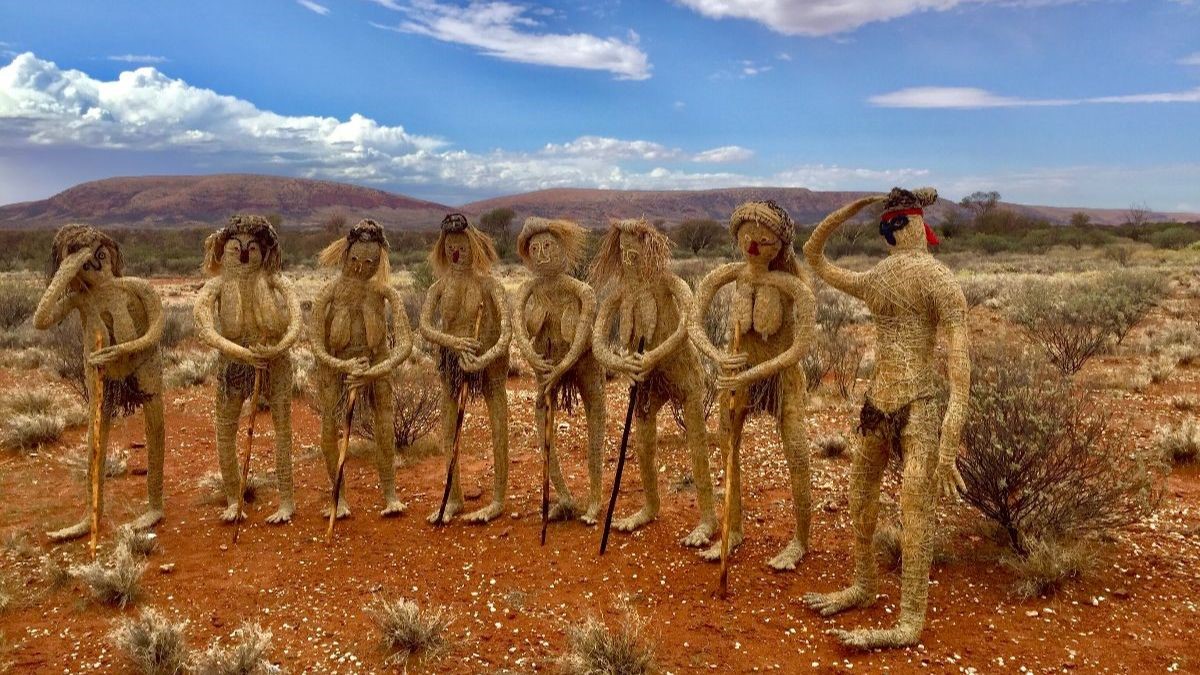
Kungkarangkalpa (Seven Sisters) by Tjanpi Desert Weavers is a collaborative large-scale installation commissioned by the National Gallery of Australia as a part of the Know My Name: Australian Women Artists 1900 to Now exhibition.

Kungkarangkalpa (Seven Sisters) is an epic ancestral story. It follows the journey of seven sisters as they are pursued across Country by Wati Nyiru / Yurla, who is chasing the eldest sister. The sisters constantly try to evade Wati Nyiru leaving traces of their journey in the landscape. In an attempt to escape, they eventually launch themselves into the sky, transforming into the stars that form the Pleiades. Wati Nyiru follows and becomes the Orion constellation. The retelling and depiction of this story relays the impact of transgressive behaviour and location of water resources necessary for survival in the desert.

Know My Name is an initiative of the National Gallery of Australia to celebrate the significant contributions of Australian women artists. The initiative aims to increase the representation of artists who identify as women in its artistic program and enhance understanding of the contributions they have made and continue to make to Australia’s cultural life.

Contributing artists: Dianne Ungukalpi Golding, Delilah Shepherd, Winifred Puntjina Reid, Dorcas Tinnimai Bennett, Martha Yunurupa Ward, Nancy Nyanyana Jackson, Polly Pawuya Jackson, Cynthia Nyungalya Burke, Erica Ikungka Shorty, Judith Yinyika Chambers, Rosalie Richards, Dallas Smythe, Roma Yanyakarri Butler.

Find out more about Tjanpi Desert Weavers

Read more
tjanpi weavers aboriginal art
Tjanpi Desert Weavers

Making the road to Warburton - Judith Chambers

The “Making the Warakurna to Warburton road” story

There was only one road from Warakurna to Warburton and it was a big distance, going the long way around, passing through Blackstone. So there was a community talk, and people wanted a road running straight from Warakurna to Warburton, to make that trip shorter.

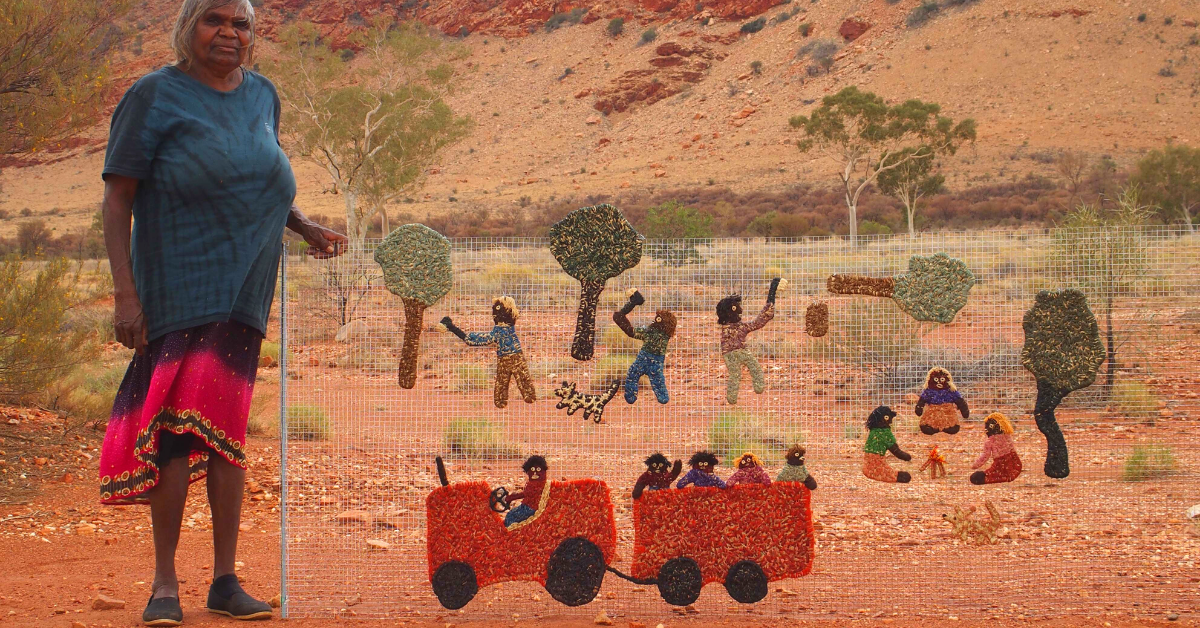
Lots of families from Warakurna and Warburton came to help make the road, men, women, children and dogs. My dad was one of those men. I was just a young girl. We started at Warburton. The men made the cutline, chopping down trees by hand with axes, and clearing grass. The women made the fire and prepared food and looked after the camp. While the adults worked we would have fun. There were lots of children and dogs running around playing together. A white man came and paid money for the work done. We all stayed out on the road until that road was finished.

Two brothers drove the tractor, taking it in turns. The tractor had a trailer which stored food, 44 gallon drums of diesel, and blankets. We would get lovely clean water from rockholes. Sometimes we would get in the trailer and play. Each day the men would clear a bit more of the road, and we would move on and camp somewhere else, getting closer and closer to Warakurna every day.

judith chambers tjanpi aboriginal art

The Artwork

Judith was commissioned by the Art Gallery of Western Australia (AGWA) Stimulus Acquisition Package 2020 to tell this story as a tjanpi sculpture. Titled ‘Making the Warakurna to Warburton Road’ The sculpture was purchased by AGWA, and will be exhibited at the AGWA Covid 19 Stimulus Art Exhibition scheduled for early May 2021.

tjanpi aboriginal art

About Judith

Judith was born in the bush at Mitika, near Jameson Community and went to school at the Warburton Mission and later at Docker River. Judith now lives in the remote community of Warakurna, WA.

Judith is an accomplished weaver, making both baskets and fibre sculptures from desert grasses that grow close to her home. Judith is renowned for her flat sculptural works which tell stories of the Ngaanyatjarra Lands, both historical and contemporary; she also uses the animals from her country as inspiration, including camp dogs, birds, goannas, porcupines and rabbits. Ancestral figures also inspire her work, and Judith’s work is very fine and detailed. Judith also paints and is represented by Warakurna Artists.

Find out more about Tjanpi Desert Weavers
Read more