Skip to content

Your donation supports the voices and leadership of Aṉangu women across the Ngaanyatjarra, Pitjantjatjara and Yankunytjatjara Lands. NPY Women’s Council is an Aboriginal-led organisation created by women for women, focused on improving health, safety, culture and community wellbeing in remote Central Australia.

We appreciate any contribution you are able to offer.

Please fill out the form below to make a donation.

Cart

Your cart is empty

Donate

Article: Anangu Domestic Violence worker talks about her job

Anangu Domestic Violence worker talks about her job

Anangu Domestic Violence worker talks about her job

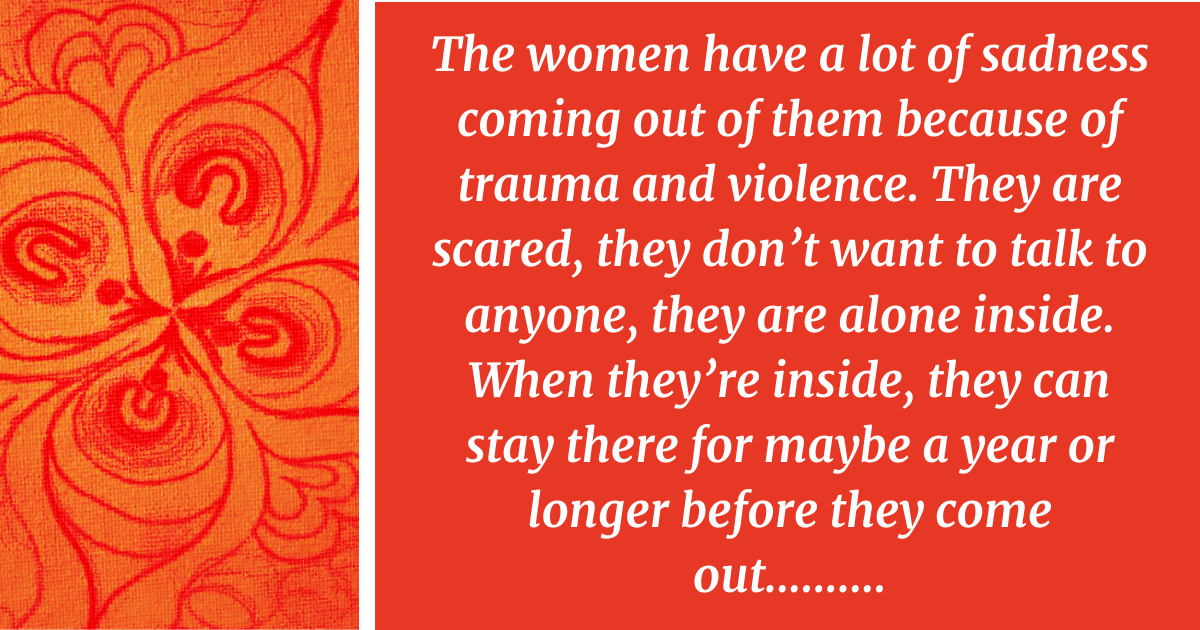
This drawing is about women sitting down, they have got sadness coming out of them because of trauma and violence. They are scared, they don’t want to talk to anyone, they are alone inside. When they’re inside, they can stay there for maybe a year or longer before they come out.

If they want to come out they have NPYWC case workers and people like that around them. It takes a while but it’s people like family and NPYWC, who can help to make them feel safe. They remember the good times again. It’s hard for them to say what is wrong because they are so scared because of the trauma and the violence.

They come out when they are ready, it happens slowly when they have love, and kids and family around them supporting them. Then they come out of the shell and back on the road to being happy. It’s like they can grow into a beautiful flower with their family, culture and community around them.

Sometimes when we have bush picnics we are all shy but we still encourage each other to speak – it’s alright because we are safe.

This is part of the way we work; we find safe ways to talk to women. We don’t go straight up to someone; we go ‘sideways’. We watch and wait for the right time.

We do things like eating, sitting and talking together, this helps women to feel safe and then they can talk.

Dianne Brown, Anangu DFVS team member.

Read more about NPY Women’s Councils Domestic & Family Violence Service
Read more

Looking after Children with Disabilities in the NPY Lands
Tjungu

Looking after Children with Disabilities in the NPY Lands

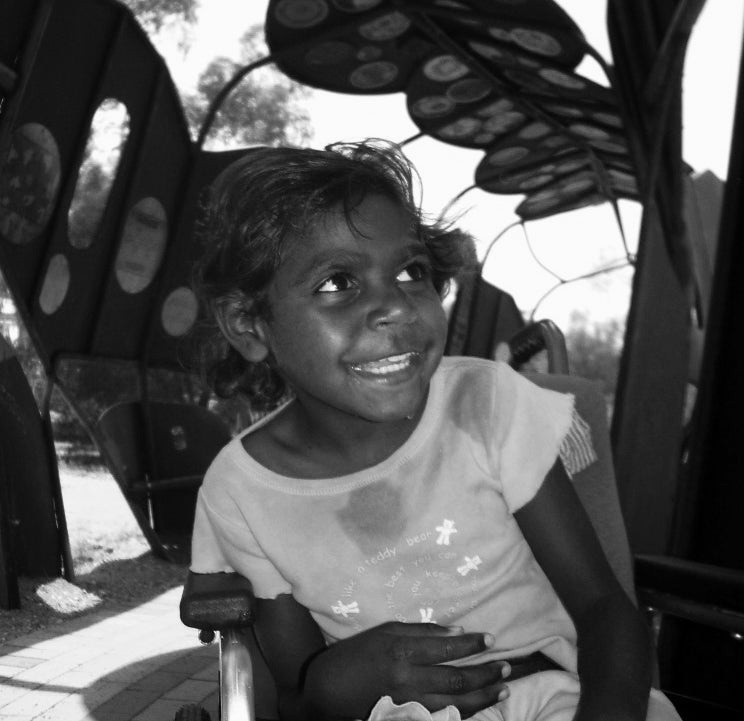
Remote carers of children with a disability raised a number of issues that impacted on their ability to give children the best possible support and quality of life in NPYWC’s Tjungu Service’s new research “Looking after Children with Disabilities from the NPY Lands” .

The research found that many carers had to focus on providing basic needs such as where the next meal was coming from, before being able to consider greater therapy requirements of children.

A major finding was the number of children who had to leave the Lands because of the lack of support services- it was too hard for family carers, who often were frail or chronically ill themselves to support children as they grew.

Some families had been obliged to surrender their parental rights in order to get appropriate help for their children.

Families grieved for their children, who had in turn, lost family, language and culture. People asked for support to find out where the children were, and to visit them. ‘I just want to cuddle my son’, said one man.

Distance to services and the need for greater cultural awareness and relationship building from service providers were also among key findings.

The research was funded by the Australian Research Council and was a collaboration between NPYWC, Sydney University, Poche NT and the Centre for Remote Health NT.

Read more about the Tjungu Aged & Disability Service

Read the “Looking after Children with Disabilities in the NPY Lands” research

Read more
Some things are more important than services
Tjungu

Some things are more important than services

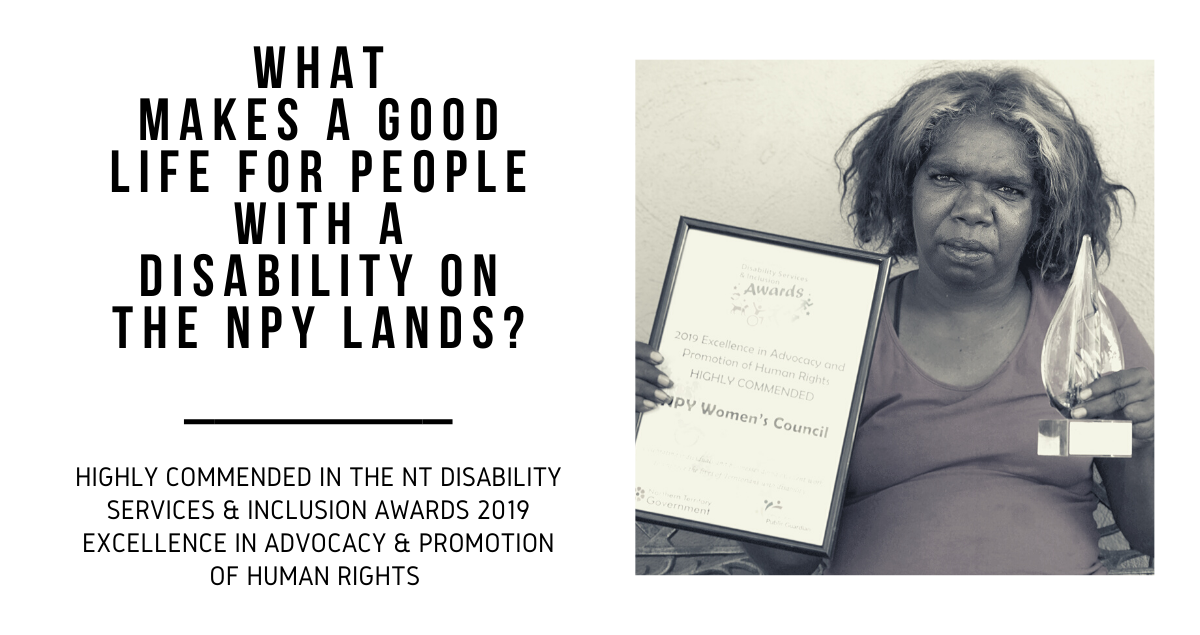
NPY Women’s Council Tjungu Aged & Disability Service is proud to be Highly Commended in the NT Disability Services & Inclusion Awards 2019 Excellence in Advocacy & Promotion of Human Rights for the Research Report “Walykumunu Nyinaratjaku” To Live a Good Life.

This research project was initiated by NPYWC and asked the question, ‘What makes a good life for Aboriginal people with a disability from the Ngaanyatjarra, Pitjantjatjara and Yankunytjatjara (NPY) Lands?

The most significant finding of this research is that Aṉangu and Yarnangu with a disability want to live in their communities, on the NPY lands, with family. This is more important to them than the quality of care they receive, or the availability of services. It is important despite the difficulties they encounter in accessing basic daily amenities including food, clothing and bedding, which remain a major priority for people living in community.

For those Aṉangu and Yarnangu with a disability who are living in community, a good life also means being included and participating in cultural, family and community activities such as arts and crafts, bush trips, bush medicine, music, television and movies, sport, socialising, spiritual life and shopping.

All interactions between Aṉangu and Yarnangu with disability, their carers, service providers and policy makers should be based on internationally recognised human rights and responsibilities. Regardless of geographic location, all people with disability should be able to obtain culturally appropriate support and the services they need to live a good life.

Read the Walykumunu Nyinaratjaku Report

Find out more about the Tjungu Team

Read more