Skip to content

Your donation supports the voices and leadership of Aṉangu women across the Ngaanyatjarra, Pitjantjatjara and Yankunytjatjara Lands. NPY Women’s Council is an Aboriginal-led organisation created by women for women, focused on improving health, safety, culture and community wellbeing in remote Central Australia.

We appreciate any contribution you are able to offer.

Please fill out the form below to make a donation.

Cart

Your cart is empty

Donate

Article: Tjanpi in Timor-Leste

Tjanpi in Timor-Leste

Tjanpi in Timor-Leste

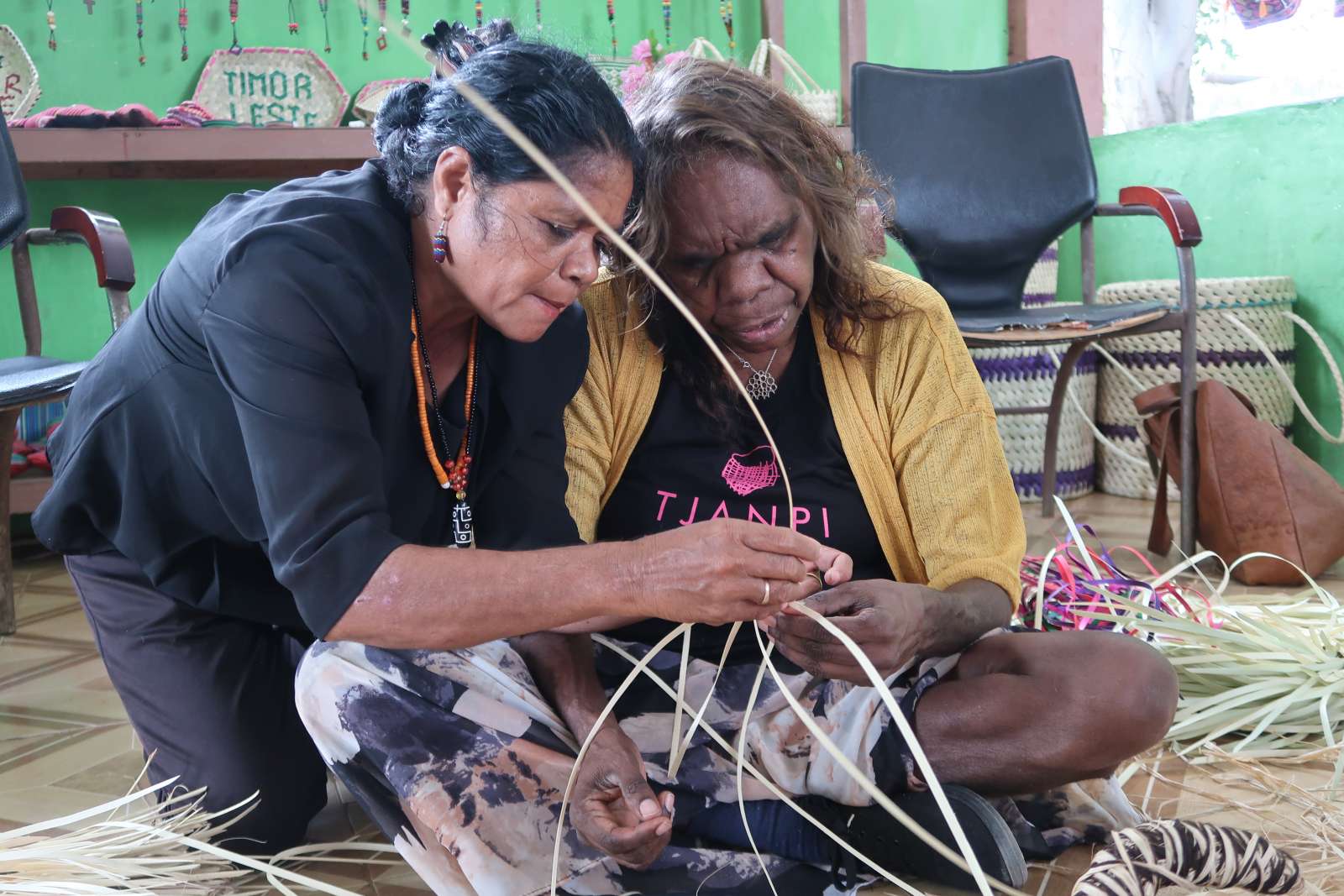
Weavers in Timor-Leste received a dose of Central Australian inspiration when representatives from Tjanpi Desert Weavers took their story to the nation during NAIDOC week.

On invitation by the Australian Embassy, artist Rene Kulitja and Tjanpi Manager Michelle Young travelled to Dili to showcase the achievement and beauty of the desert weavers’ work and share the way their artistic practice has developed.

For Timorese women, weaving is currently seen as a handicraft and cultural expression. In contrast, Tjanpi has grown their practice to a contemporary art form, and their artists exhibit work around Australia and the world.

Ms Young said the way Tjanpi has positioned itself was of great interest the Timorese women.

“Tjanpi has evolved its arts practice over many years, developing a distinctive and innovative art form and they found that very interesting,” Ms Young said.

“They saw the artistic achievements of Tjanpi as a great example, and I think it planted a seed for those women that doing things differently can have great value.”

During the week, Ms Kulitja and Ms Young took part in several NAIDOC week events in Dili to showcase the Tjanpi story to NGOs, government ministers, and women weavers, before travelling to Maubara to spend time with local weavers in their community.

Ms Young said the experience was “affirming”.

“It reminded us to be mindful of what we have achieved over the years; we’ve done a lot of work in this space that we can be proud of,” she said.

“After twenty plus years we’re a well-oiled machine, and it really highlighted our ability to evolve and adapt our practice and model of working, which I think they found inspiring.”

Tjanpi Desert Weavers is a social enterprise of NPY Women’s Council. They represent more than 400 Aboriginal women in the NPY Lands, enabling them to earn their own income from fibre art.

Read more

CEO Andrea Mason speaks the Australian Press Club

CEO Andrea Mason speaks the Australian Press Club

NPY Women’s Council CEO Andrea Mason addressed the Australian Press Club on 12 July 2018 on the program of the NAIDOC Women’s Conference. Below are the words she shared with delegates.

NPY Women’s Council established its Domestic and Family Violence Service (DFV) in 1994. The service initially focused on assisting women to gain access to the criminal justice system. This was what was needed at the time. In the context of NPY Women’s Council as a whole and the changing context of remote communities over that time the service has recently taken on a different focus.

Whilst we know we still have a role to play in crisis work, and in helping women through the legal system, we now know this is not enough. The last two years in particular has seen major changes to how we approach this issue. These changes have been driven by the women (Directors, members and senior management…) who want to work from a position of strength rather than deficit. The old paradigm of domestic and family violence keeps us locked in the deficit position – seeing women as victims on a spectrum of risk and perpetrators on a parallel spectrum of risk.

This paradigm limited our ability to consider different ways of supporting women who have experienced violence, and different ways of working to end violence.

We now clearly articulate that we work from a holistic and relational standpoint which is strongly aligned with Anangu values and the agency of our women. We understand that violence does not occur in a vacuum. And we understand that in our context there is no simple or leading explanation as to why violence occurs.

Our new approach has been influenced by new understandings of trauma and toxic stress which NPYWC as a whole has been working on in different ways. In one example of our work in this area, a group of senior lore women (UK team) have been meeting for the past few years to consider these issues and develop shared meanings for Anangu and Western ways of understanding of the impact of trauma and toxic stress. Their work has been healing and transformative for them and they have developed resources that assists others in their healing process especially young people and children.

The significance of this kind of work has been personally profound for the women involved and profound in the kinds of advice that they have provided for the rest of the organisation. We are now working with a group of senior lore men in the same way specifically on the topic of DFV.

Our focus now is to shine a light on the strengths that will help the collective transformation that we know our members want to see for their communities. In relation to DFV this means shifting the focus from cycles of family and community violence to cycles of care and resilience. We have a practice framework for staff that outlines how their work is best conducted to ensure we are supporting our members to achieve this vision of collective transformation. Our practice framework, which was developed in partnership with the Australian Childhood Foundation, lays out for us where our focus should be. Our job is to support women and communities to: collaboratively understand violence, name its effects, tell stories of renewal acknowledge pain, listen deeply, find connection, validate resistance to violence and resource safety.

The DFV service is now very clearly committed to learning about and understanding:

  • how violence occurs in the community and how it is being challenged and resisted;
  • the importance of culture and cultural maintenance;
  • about trauma and healing;
  • about narrative approaches to working with communities’ own efforts to resist and challenge violence; and finally
  • ways to enhance community resilience.

Our approach is aligned with what we know to be the aspirations of our members, but it has taken time to get to this place of confidence in the new focus of our work in DFV. We have built on our knowledge of this area gained over many years. We have been able to embed our DFV service within our overall organisation which is already involved in healing work, cultural maintenance and other activities that we know to be enhancing of wellbeing. And we have had to work with the expectations of our funders. Very importantly though, we have been very open to working in genuine partnership with other experts and organisations, such as the Australian Childhood Foundation who assisted us to articulate this new way of working.

Read more
UPK6 launches into the stratosphere

UPK6 launches into the stratosphere

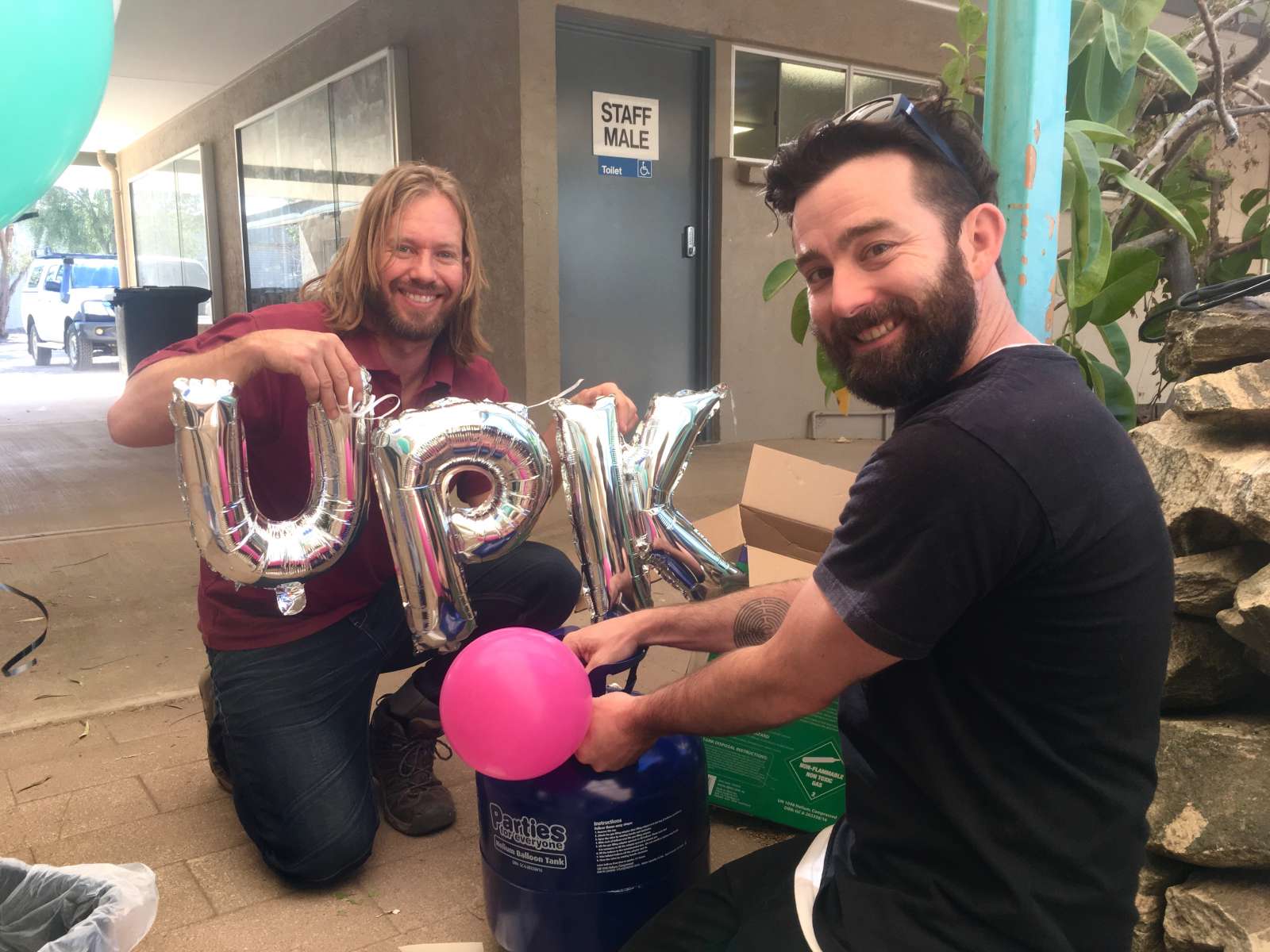
In August NPY Women’s Council celebrated its first involvement with the UPK music program; an initiative of the Nganampa Health Council that uses music to create awareness and inspire action about issues faced by Anangu (people of the Western Desert).

On Thursday a USB carrying the sixth UPK album was launched into the world aboard a balloon ship, it comes almost 30 years after the first instalment was recorded at Mutitjulu in 1989. The current album was also released on Bandcamp and Soundcloud.

UPK stands for Uwankara Palyanku Kanyintjaku; a Pitjantjatjara expression meaning ‘everybody building and caring for the future’.

Using music is an agent of change, the songwriters involved take aim the root causes of hurt they see around them, like petrol sniffing, alcohol and drug addiction, waste management, care-for-country, hunting, and homesickness.

The content of UPK songs is not about blame or victimhood but a musical effort to address the factors that contribute to, or impact on, good living.

Creating awareness is the intention of UPK music because it is the key precedent to positive action.

UPK6 was recorded at West Bore in the APY Lands using an open-air studio with a hessian fence for wind-break, used carpet to keep the dirt down, and digital recording gear housed in the front room of an old outstation home.

The resulting album was released on the APY Lands in the form of a USB slap band containing the whole album, plus a karaoke version complete with scrolling Pitjantjatjara lyrics.

The Launching of UPK6

The launching of the long-awaited sixth album of the UPK series, UPK6, takes place today at the offices of the Pitjantjatjara Council. The intention of UPK music is to draw attention to the elements of life that constitute lifestyle, either negatively or positively and therefore influence the quality of life.

The long history of UPK music as a generic form of contemporary Aboriginal music has been an effective and stimulating – from the very first recording made at Mutitjulu in 1989 to the most recent recording made at West Bore a long way to the south, on the APY Lands.

UPK Music

UPK Music is about Life. Its songs reflect the elements needed to make Life good. However, to continue the time honoured practice of songwriters everywhere, UPK Music songwriters take aim at the root causes of unwellness and social malaise.

UPK music has been the most popular music on the APY Lands in far north SA for more than 30 years.

UPK6

The music of UPK6 is the most recent original music to spring from the music scene on the APY Lands. The songs have a fresh, content-rich, contemporary feel. Pitjanjatjara rock anthems, lush desert dub, poignant acoustic ballads; all songs of the UPK music genre, rich, and varied.

As with all other UPK albums the recording of UPK 6 occurred in a remote bush location, away from all distraction. West Bore, in the very centre of the APY Lands, was the location visited by musicians from right across the Lands who came to record their songs and support one another. An ‘open-air studio’ with a hessian fence for wind-break, used carpet to keep the dirt down and digital recording gear housed in the front room of an old outstation home was the scene of recording action. All UPK music has been recorded this way.

Contact person:

UPK6 Music Director Bill Davis 0407 527706

Read more